Skin Microbiome and Modern Skincare
What this means for your routine
This article introduces the skin microbiome; it cannot tell you which ingredient or product your own skin needs. Consider the evidence for a particular product separately from the appeal of a scientific term.
Understanding skin microbial communities
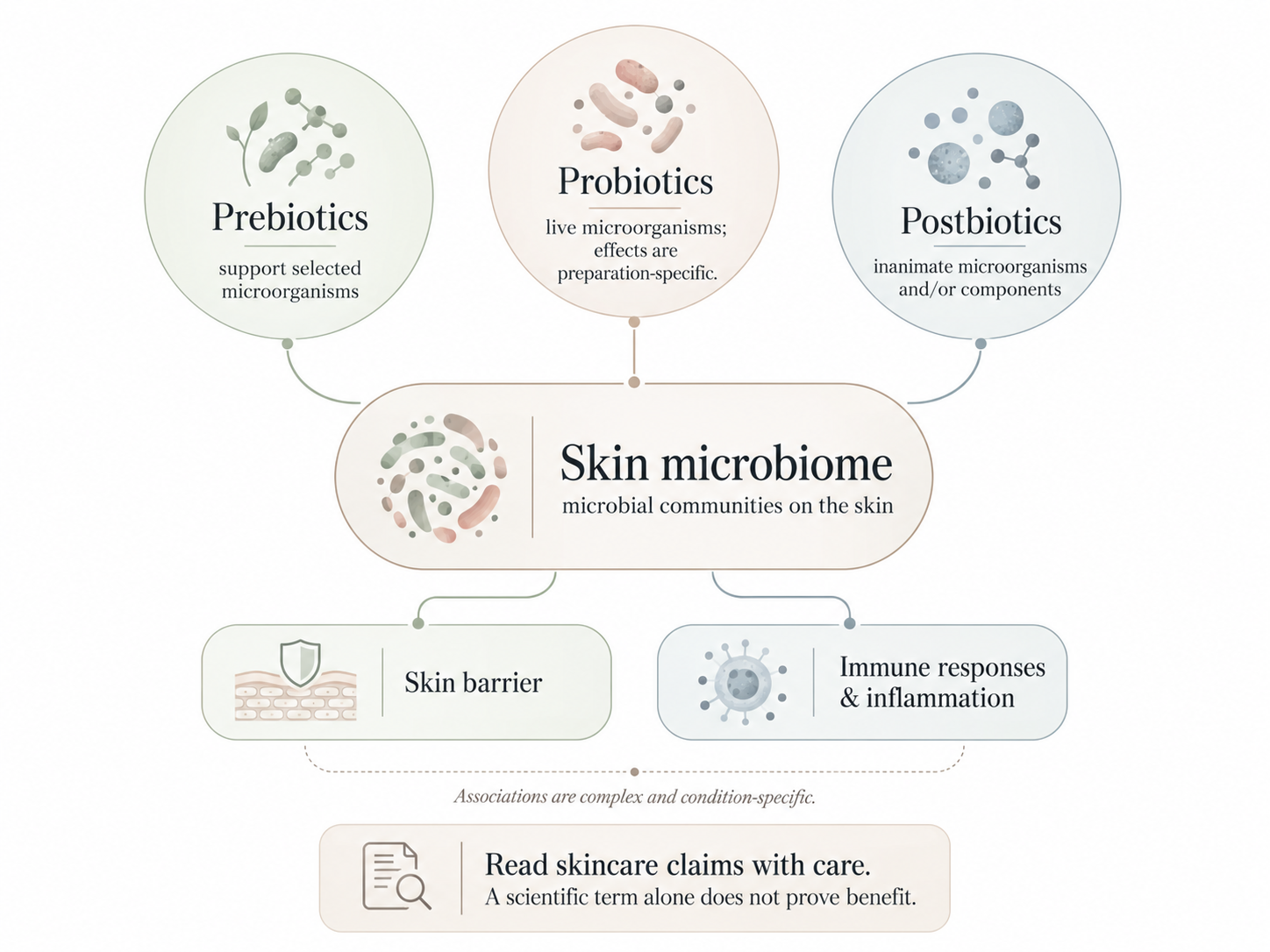
The skin microbiota comprises the microorganisms living on the skin; the term skin microbiome is often used more broadly for these communities and their biological context. The skin hosts diverse microbial communities. Their abundance and composition vary by body site and sampling method. [1, 2]
The skin barrier, immune responses and inflammation
Changes in microbial communities are associated with several inflammatory skin conditions. Their relationship with the skin barrier and immune responses is complex and differs between conditions; a microbiome change alone does not identify a diagnosis or its cause. [3, 8]
In recent years, the study of the skin microbiome has led to the development of a new generation of skincare products that focus on supporting the growth and diversity of beneficial microorganisms. One of the key players in this category are prebiotics.
Prebiotics: evidence matters
A prebiotic is a substance selectively used by host microorganisms in a way that provides a health benefit. Whether a skincare ingredient meets that definition depends on evidence for its intended use. An ingredient name alone does not establish a benefit for the skin barrier. [4]
Probiotics: findings are preparation-specific
Probiotics are live microorganisms that, when administered in adequate amounts, confer a health benefit on the host. Some topical microbial preparations have been studied for particular skin conditions, but their findings cannot be generalized to all skincare products. Clinical effects must be evaluated for the specific preparation and intended use.
The probiotic definition is set out in the ISAPP consensus statement. Clinical studies and reviews of topical microbial approaches should be read in the context of the preparation and condition investigated. [5, 7, 8]
Postbiotics: more than isolated metabolites
Postbiotics are preparations of inanimate microorganisms and/or their components that confer a health benefit on the host. Purified microbial metabolites alone do not meet this definition. [6]
This distinction follows the ISAPP consensus definition of postbiotics. [6]
Reading skincare claims with care
Terms such as “microbiome-friendly” should be interpreted alongside evidence for the finished product. They do not, by themselves, demonstrate a therapeutic effect, guarantee that the microbial community will remain unchanged, or establish a rejuvenating benefit.
For your own routine, the useful question is what evidence supports the particular product and its intended use. A scientific-sounding label is not a substitute for that evidence.
Where to go next
Thinking about a routine that no longer feels right? Discover your Skin Longevity starting point to choose a relevant next read. If you want a structured way to organize your decisions, explore The Skin Longevity Blueprint and what it includes.
The Blueprint is an educational resource for organizing your thinking, not a treatment for a skin condition.
References
- Grice EA, et al. A diversity profile of the human skin microbiota. Genome Research. 2008;18:1043–1050.
https://pmc.ncbi.nlm.nih.gov/articles/PMC2493393/ - Oh J, et al. Biogeography and individuality shape function in the human skin metagenome. Nature. 2014;514:59–64.
https://doi.org/10.1038/nature13786 - Kong HH, et al. Temporal shifts in the skin microbiome associated with disease flares and treatment in children with atopic dermatitis. Genome Research. 2012;22:850–859.
https://pubmed.ncbi.nlm.nih.gov/22310478/ - Gibson GR, et al. ISAPP consensus statement on the definition and scope of prebiotics. Nature Reviews Gastroenterology & Hepatology. 2017;14:491–502.
https://doi.org/10.1038/nrgastro.2017.75 - Hill C, et al. ISAPP consensus statement on the scope and appropriate use of the term probiotic. Nature Reviews Gastroenterology & Hepatology. 2014;11:506–514.
https://doi.org/10.1038/nrgastro.2014.66 - Salminen S, et al. ISAPP consensus statement on the definition and scope of postbiotics. Nature Reviews Gastroenterology & Hepatology. 2021;18:649–667.
https://doi.org/10.1038/s41575-021-00440-6 - Nakatsuji T, et al. Development of a human skin commensal microbe for bacteriotherapy of atopic dermatitis and use in a phase 1 randomized clinical trial. Nature Medicine. 2021;27:700–709.
https://doi.org/10.1038/s41591-021-01256-2 - Greenzaid JD, et al. Microbiome modulators for atopic eczema: a systematic review of experimental and investigational therapeutics. Expert Opinion on Investigational Drugs. 2024;33:415–430.
https://pubmed.ncbi.nlm.nih.gov/38441984/